
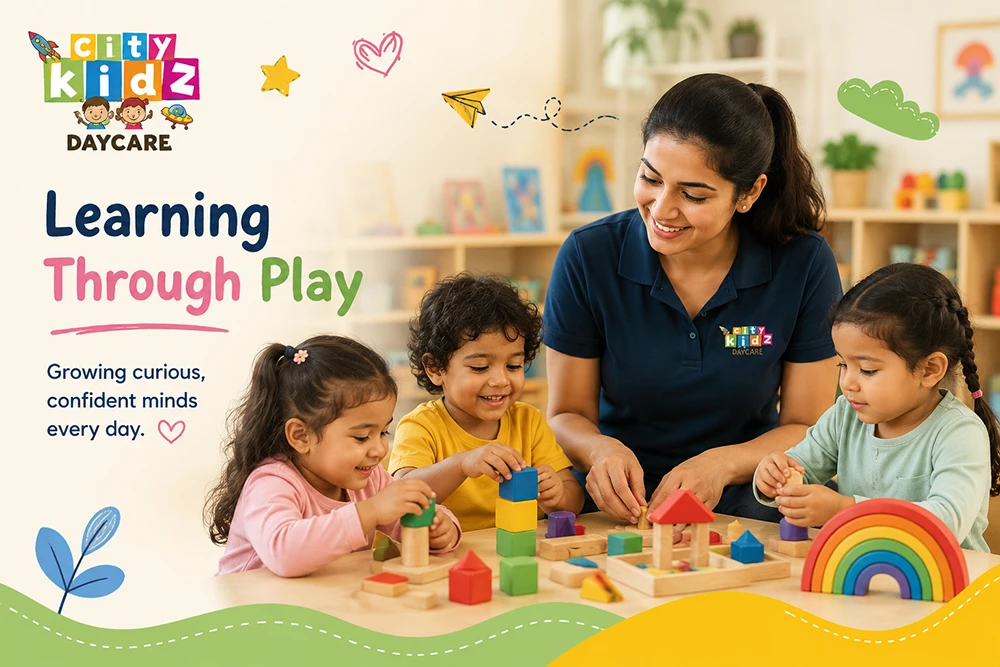
Understanding Play-Based Learning in Early Childhood
Play is one of the most natural ways young children explore the world around them. When children play, they are not simply having fun—they are discovering new ideas, practicing important skills, expressing themselves, and learning how to interact with others.
Play-based learning gives children opportunities to learn through activities that are engaging, meaningful, and appropriate for their stage of development. Instead of expecting young children to learn only through structured lessons, play allows learning to happen naturally through exploration and curiosity.
What Is Play-Based Learning?
Play-based learning is an approach where children develop knowledge and skills through play and hands-on experiences.
Children might build with blocks, create artwork, play pretend games, explore sensory activities, listen to stories, complete puzzles, or participate in group activities. Each experience can support different areas of development.
The educator’s role is also important. Educators can observe children’s interests, provide appropriate activities, ask questions, and encourage children to explore ideas further.
How Play Supports Early Development
Play can support many areas of a child’s development at the same time.
1. Creativity and Imagination
Pretend play gives children opportunities to create their own stories and ideas. A simple collection of toys can become a kitchen, a store, a classroom, or an imaginary adventure.
These experiences encourage children to think creatively and express themselves in their own way.
2. Problem-Solving Skills
When children play with puzzles, blocks, building materials, or games, they often encounter small challenges.
They may ask themselves:
How can I make this tower taller?
Where does this piece fit?
What should I try next?
Working through these challenges helps children practice problem-solving and learn that trying different approaches can lead to new solutions.
3. Social Skills
Playing with other children gives young learners valuable opportunities to practice social interaction.
Children learn to:
- Share and take turns
- Communicate their ideas
- Listen to others
- Cooperate during activities
- Work through disagreements
- Build friendships
These everyday experiences help children become more comfortable interacting with people around them.
Play Helps Children Build Confidence
Children gain confidence when they discover that they can do things independently.
Completing a puzzle, building something, creating artwork, or successfully explaining an idea can give a child a sense of accomplishment.
Educators can support this process by encouraging children to try, allowing them time to explore, and celebrating their efforts rather than focusing only on the final result.
Over time, these small experiences can help children become more willing to try new things.
Physical Development Through Play
Play is also important for physical development.
Activities such as running, jumping, climbing, dancing, throwing, and outdoor games allow children to develop coordination, balance, strength, and body awareness.
Fine-motor activities are important too. Drawing, painting, building with blocks, using play materials, and completing puzzles can help children practice the smaller movements needed for everyday tasks.
A balanced learning environment can provide opportunities for both active physical play and quieter hands-on activities.
Language and Communication Skills
Children naturally use language during play.
When children pretend to run a restaurant, build a house together, or create a story, they are communicating ideas and learning new vocabulary.
Educators can extend this learning by asking open-ended questions such as:
“What are you building?”
“What do you think will happen next?”
“Can you tell me about your picture?”
These conversations encourage children to explain their thinking and express themselves.
Learning Through Curiosity
Young children are naturally curious. They want to touch, explore, ask questions, and understand how things work.
Play-based learning gives children room to follow that curiosity.
For example, an educator might provide different objects and encourage children to sort them by size, shape, or colour. The children may think they are simply playing, but they are also developing early mathematical and observation skills.
This is one of the strengths of play-based learning: children can learn important concepts while remaining actively engaged in the experience.
The Role of Educators in Play-Based Learning
Play-based learning does not mean children are simply left to play without guidance.
Skilled educators create environments where children can explore safely while providing support and encouragement when needed.
Educators can:
- Observe children’s interests
- Introduce new materials
- Ask questions
- Encourage cooperation
- Help children solve problems
- Extend children’s ideas
- Provide age-appropriate challenges
This balance allows children to have independence while still receiving meaningful guidance.
Why a Positive Learning Environment Matters
Children learn best when they feel comfortable, supported, and encouraged.
A welcoming environment can help children feel confident enough to explore new activities, make mistakes, ask questions, and try again.
For parents choosing a childcare program, it can be helpful to ask how the daycare creates opportunities for children to learn through play throughout the day.
You can learn more about the learning experiences available at CityKidz Daycare by visiting our Our Programs page.
Play and Learning Can Happen Together
One of the biggest benefits of play-based learning is that learning and enjoyment do not have to be separate experiences.
A child building with blocks can develop early mathematical thinking.
A child painting can explore creativity and fine-motor skills.
A child playing with friends can practice communication and cooperation.
A child listening to a story can develop language and imagination.
These experiences can happen naturally when children are given the time, space, and encouragement to explore.
How Parents Can Encourage Play-Based Learning at Home
Parents don’t need expensive toys or complicated activities to encourage learning through play.
Simple everyday activities can create meaningful learning opportunities.
Try:
- Building towers with blocks
- Reading stories together
- Drawing and colouring
- Playing pretend games
- Sorting household objects
- Making simple crafts
- Exploring nature outdoors
- Completing age-appropriate puzzles
- Singing songs and dancing together
The most important part is giving your child opportunities to explore and encouraging them to talk about what they are doing.
Final Thoughts
Play is an important part of childhood, and it can be a powerful way for young children to learn and develop.
Through play-based learning, children can build creativity, communication skills, confidence, problem-solving abilities, social skills, and physical coordination while exploring the world around them.
For parents considering childcare, understanding how a daycare approaches learning through play can help you choose an environment that supports your child’s development.
At CityKidz Daycare, we believe children benefit from opportunities to learn, explore, create, and grow in a supportive environment.
Want to learn more about our programs? Explore CityKidz Programs or Book a Tour and come see our learning environment for yourself.