
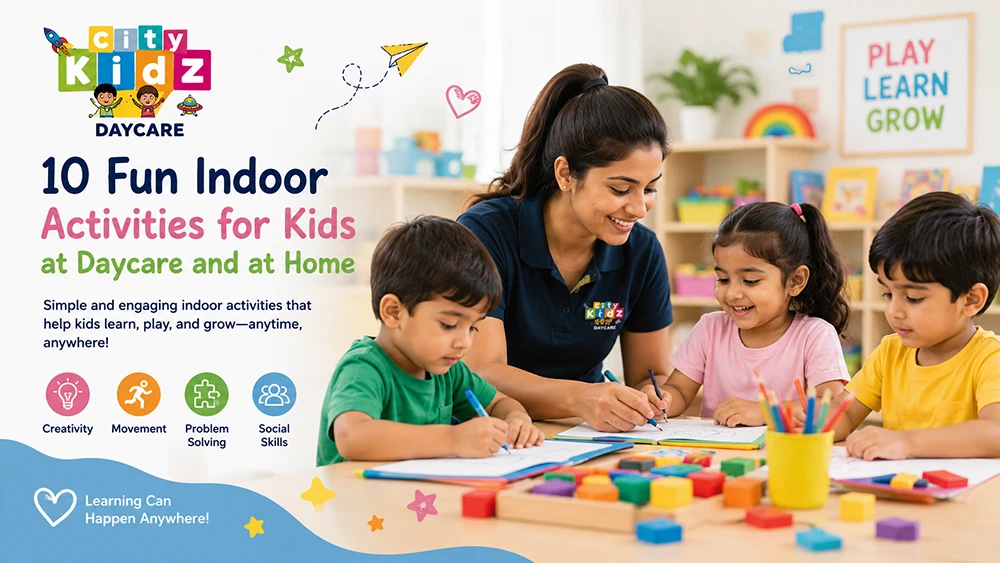
Fun Indoor Activities That Help Kids Learn and Grow
Rainy days, cold weather, or simply a day when outdoor play isn’t possible don’t have to mean boring time for children. Indoor activities can be just as exciting and can give young children opportunities to create, explore, move, communicate, and learn through play.
Whether you’re a parent looking for ideas to try at home or an educator planning activities for children, simple materials and a little creativity can turn an ordinary indoor space into a fun learning environment.
1. Build a Block City
Give children building blocks, cardboard boxes, or other safe building materials and invite them to create their own city.
They can build houses, roads, bridges, schools, stores, or anything else they imagine.
This activity encourages:
- Creativity and imagination
- Problem-solving
- Fine-motor skills
- Spatial awareness
- Cooperative play
You can make it even more engaging by asking children to explain what they have built.
“Where does this road go?” or “Who lives in this house?” can turn building into a storytelling activity.
2. Create an Indoor Art Station
Art doesn’t have to be complicated.
Set up a small space with paper, crayons, washable markers, coloured pencils, or child-safe craft materials. Let children decide what they want to create.
Instead of giving every child exactly the same project, allow them to make their own choices.
They might draw their family, create a colourful picture, make shapes, or simply experiment with different colours.
The goal isn’t a perfect picture. It’s giving children an opportunity to express themselves and enjoy the creative process.
3. Have a Storytelling Adventure
Choose a children’s book and make reading time interactive.
After reading the story, ask children questions about the characters and what happened.
For example:
- What was your favourite part?
- What do you think happens next?
- How did the character feel?
- What would you do?
You can also encourage children to create their own ending or act out part of the story.
This supports language development, imagination, listening skills, and communication.
4. Try a Simple Indoor Treasure Hunt
A treasure hunt can turn an ordinary room into an adventure.
Hide a few safe objects around the room and give children simple clues to follow.
For younger children, you can make the clues based on colours, shapes, or familiar objects.
For example:
“Can you find something red?”
“Can you find something that is round?”
This activity encourages observation, movement, listening, and problem-solving.
5. Make a Pretend-Play Corner
Children naturally love pretending.
A small collection of safe everyday items can become a restaurant, grocery store, doctor’s office, classroom, or family home.
Pretend play allows children to experiment with different roles and situations while developing communication and social skills.
Encourage children to create their own stories rather than directing every part of the game.
You may be surprised by how creative their ideas can become.
6. Make a Simple Puzzle Challenge
Puzzles are a great indoor activity for quiet learning time.
Choose puzzles that are appropriate for the child’s age and ability. Younger children can begin with simple large-piece puzzles, while older preschoolers may enjoy more detailed challenges.
Puzzles can encourage children to practice:
- Observation
- Concentration
- Matching
- Patience
- Problem-solving
- Fine-motor coordination
When a child gets stuck, try asking a question rather than immediately solving it for them.
“What piece could fit here?” gives them an opportunity to think through the problem.
7. Have a Music and Movement Session
Indoor play doesn’t always need to be quiet.
Put on some child-friendly music and give children space to move, dance, clap, jump, or follow simple movement instructions.
You can turn it into a game:
“Jump like a frog.”
“Move slowly like a turtle.”
“Reach up like a tall tree.”
Music and movement can help children develop coordination, body awareness, listening skills, and confidence while having fun.
8. Explore Colours and Shapes
Learning about colours and shapes can become a playful activity rather than a formal lesson.
Give children safe objects and ask them to sort them by colour, shape, or size.
You could create simple challenges such as:
“Can you find three blue objects?”
or
“Which objects are circles?”
Children can also create their own patterns using blocks, paper shapes, or other materials.
These simple activities introduce early mathematical thinking while keeping children actively involved.
9. Create a Sensory Play Activity
Sensory activities allow children to explore different textures, shapes, sounds, and materials.
Depending on the child’s age, you might use safe materials such as play dough, water, textured fabrics, or other age-appropriate objects.
Always choose materials carefully and supervise young children closely, especially around small objects.
Ask children what they notice.
“How does it feel?”
“Is it soft or hard?”
“What happens when you mix these?”
These conversations can turn sensory exploration into a rich learning experience.
10. Build a Simple Indoor Obstacle Course
If you have enough safe space, create a simple obstacle course using cushions, soft objects, tape lines, or other appropriate materials.
Children might:
- Walk along a line
- Crawl under something
- Step over a soft object
- Jump between marked spaces
- Carry a lightweight object
Keep the activity age-appropriate and make sure the area is safe and free from hazards.
Indoor movement activities can help children stay active while practicing balance, coordination, and following instructions.
Making Indoor Activities More Meaningful
The best activities don’t necessarily require expensive toys or complicated preparation.
What matters most is giving children opportunities to explore, make choices, communicate, and use their imagination.
Parents and educators can make almost any activity more meaningful by asking questions and allowing children to explain their ideas.
Instead of simply saying:
“That’s a nice drawing.”
try:
“Tell me about your picture.”
This encourages children to communicate and gives adults a chance to understand what they are thinking.
Choosing Activities for Different Ages
Not every activity will work for every child.
A toddler may enjoy simple sorting, sensory exploration, music, and large building blocks. Preschool-aged children may be ready for more complicated puzzles, pretend-play scenarios, crafts, and problem-solving challenges.
When choosing an indoor activity, consider:
- Your child’s age
- Their interests
- Their current abilities
- The available space
- Safety requirements
- How much adult supervision is needed
The goal is not to make every activity educational in a formal sense. Children can learn naturally when they are interested, engaged, and having fun.
Indoor Play at CityKidz Daycare
At CityKidz Daycare, children can experience a supportive environment where learning, creativity, social interaction, and play are part of their day.
Age-appropriate activities can give children opportunities to explore their interests while developing important skills and confidence.
If you’re looking for childcare in Edmonton and want to learn more about our programs, visit our Our Programs page.
You can also Book a Tour to visit CityKidz Daycare and see our environment for yourself.
Final Thoughts
Indoor activities can provide much more than a way to keep children busy when they can’t play outside.
Building, drawing, reading, pretending, dancing, sorting, exploring, and solving puzzles can all create opportunities for children to develop important skills while enjoying themselves.
The next time you’re looking for something fun to do indoors, start with something simple. A few blocks, some paper and crayons, a favourite story, or a little imagination may be all you need.
For children, learning can happen anywhere—and sometimes the simplest activities create the most memorable moments.